
Ba Duan Jin: Eight Movements, Three Hundred Years of Transmission, and a Living Method for Health

An internal system shaped by necessity, not comfort
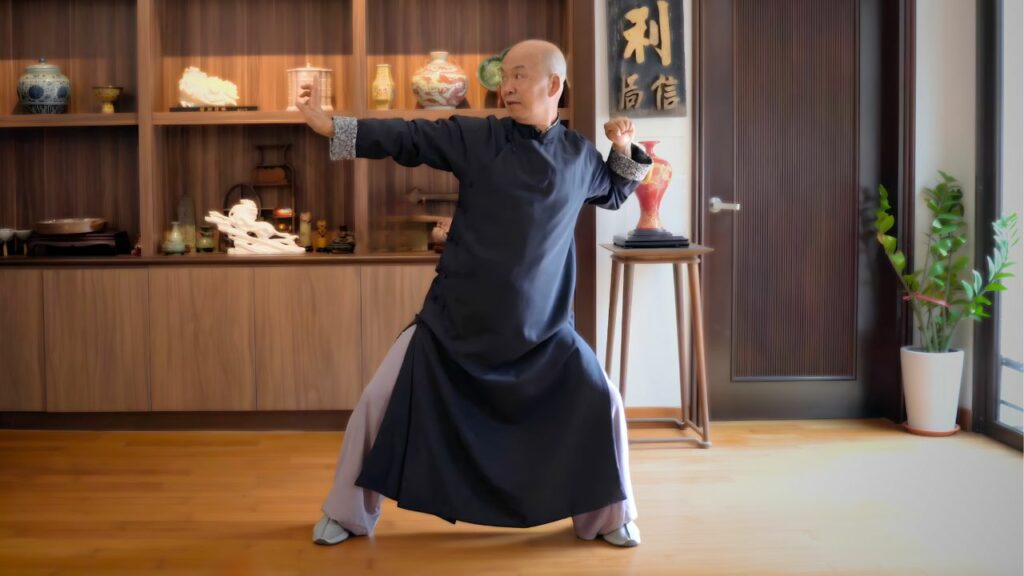
In the shadow of Songshan, one of China’s sacred mountains, there is a sense that time has never entirely loosened its grip. The landscape itself feels shaped by continuity rather than change, and it is within this environment that many of China’s most enduring internal traditions were formed. Ba Duan Jin—today commonly translated as the Eight-Section Brocade—belongs to this lineage of methods that were not created for performance or display, but for survival, resilience, and long-term cultivation of the human being.
As explained by Master Jiao Hongmin, the current official lineage holder of the Songshan Jiao Family Ba Duan Jin, the origins of this system lie not in leisure or ideal conditions, but in sustained intellectual and physical pressure. More than three hundred years ago, a scholar-physician from the Jiao family was entrusted with compiling the official chronicles of the Shaolin Temple. This was not symbolic work. It demanded prolonged concentration, exhaustive research, and physical endurance under harsh living conditions. Winters were bitterly cold, summers oppressive, and there were no modern comforts to soften the strain. Yet the work had to be completed accurately and with clarity.
Faced with these realities, the question was not how to push harder, but how to remain functional—physically, mentally, and emotionally—over long periods of sustained effort. The solution did not come from force or intensity. Instead, the scholar drew upon ancient medical texts, the lived knowledge of martial monks, and Taoist principles concerning breath, balance, and internal regulation. Through this synthesis, Ba Duan Jin emerged as a practical system designed to restore vitality, stabilise the mind, and preserve health under pressure. Refined over generations and preserved within the Jiao family, it survived not because it was fashionable, but because it worked.
Modern training, old problems
To understand why Ba Duan Jin remains relevant today, Master Jiao places it within the modern Shaolin environment. Dengfeng City now hosts roughly twenty martial arts schools, with over one hundred thousand practitioners training Shaolin Kung Fu. Each school has its own characteristics and methods, yet across this diversity a familiar problem appears repeatedly: overexertion without adequate regulation.
Master Jiao speaks about this from direct experience. In his earlier years, he trained intensively and achieved high-level success, including winning gold medals. Yet the physical cost accumulated quietly. Over time, his legs became so damaged that walking itself became difficult, a condition that affected him for nearly twenty years. Modern methods offered little resolution. It was only through returning to traditional culture—medical techniques, health practices, and internal training methods preserved by his ancestors—that genuine recovery became possible.
This experience reshaped his understanding of training entirely. Ba Duan Jin, he explains, was never designed to be practiced obsessively or mechanically. Repeating the sequence dozens of times in a single session is unnecessary and often harmful. Overexertion damages the body rather than strengthening it. Instead, Ba Duan Jin functions as a regulatory system, balancing tension and relaxation, effort and recovery, speed and slowness. It is not meant to replace martial training, but to make it sustainable.
For martial artists in particular, this balance is critical. Excessive rigidity causes internal imbalance, weakening the practitioner’s root and destabilising the system as a whole. Ba Duan Jin restores softness without collapse, relaxation without loss of structure, and calmness without passivity. Even the seated versions of the practice are emphasised as a form of “double relaxation,” allowing both body and mind to recover after intense physical training or prolonged stress.
Regulation beyond the muscles
The effects of Ba Duan Jin extend far beyond joints and muscles. Through slow, deliberate movements coordinated with breath and awareness, the practice encourages relaxation of blood vessels, improved circulation, and activation of acupoints and meridians. From the perspective of Chinese medicine, this supports internal balance and resilience. From a modern physiological perspective, it calms the nervous system and allows the body to shift out of a chronic stress response.
Master Jiao places particular emphasis on Ba Duan Jin’s relevance to modern emotional health. While ancient practitioners faced hunger, cold, and physical hardship, contemporary life produces a different kind of strain: chronic anxiety, irritability, emotional volatility, and mental fatigue. From the standpoint of Chinese medicine, prolonged emotional tension disrupts liver and gallbladder function, constricts the chest, and blocks the smooth flow of energy throughout the body. Modern people often attempt to discharge this pressure through extremes—anger, confrontation, or emotional outbursts—but these rarely resolve the underlying imbalance.
Ba Duan Jin offers a quieter and more effective approach. By gently opening the chest, relaxing the armpits and shoulder blades, and releasing the waist and hips, the practice creates internal space for emotional pressure to dissolve naturally. Master Jiao notes that even brief practice—one or two movements for a minute or two—can produce a tangible shift. Emotional agitation softens, the body settles, and the practitioner’s overall presence changes. When emotions adjust, one’s entire internal state changes with them, allowing life to move with less resistance.
The depth hidden in simplicity
One of the most persistent misunderstandings surrounding Ba Duan Jin is its apparent simplicity. To experienced martial artists, eight slow movements can appear unimpressive or even trivial. Master Jiao acknowledges that many practitioners initially dismiss the practice for this reason, assuming that slowness equates to lack of value. Yet this perception dissolves once the system is properly understood.
Within the traditional transmission, a single movement can require one or two hours to explain fully. Each posture carries specific physiological, psychological, and internal functions. The depth of Ba Duan Jin lies not in outward complexity, but in the internal state it cultivates. Proper practice leads beyond memorisation into a condition of self-absorption, where form, breath, and intention merge into a unified experience.
As this process unfolds, the spine relaxes, the nervous system settles, and the body enters a state of ease. Traditional theory describes this as supporting the generation of essence, the nourishment of the brain, and the cultivation of clarity. Whether described through classical language or modern understanding, the outcome is the same: a more regulated, resilient human system capable of adapting rather than breaking under pressure.
Virtue, longevity, and responsibility
For Master Jiao, Ba Duan Jin ultimately belongs within the ethical framework of traditional martial arts. True practice, he explains, is rooted in virtue. Skill and internal energy are not pursued for dominance or display, but to cultivate stability, clarity, and the capacity to contribute meaningfully to society. Without this foundation, technique becomes hollow and strength becomes destructive.
Ba Duan Jin supports this process by restoring balance at every level—physical, emotional, and mental. Through consistent, moderate practice, the individual becomes calmer, healthier, and more grounded. From this state, skill naturally serves purpose, and training becomes an expression of responsibility rather than ego.
Learning as transmission, not imitation
Master Jiao is clear that Ba Duan Jin cannot be learned through imitation alone. While the forms are initially learned visually, genuine understanding develops as memorisation fades and embodied awareness deepens. Over time, the practitioner moves beyond copying movements and enters a state where practice becomes internalised. Breath, movement, and awareness align naturally, and the practice begins to regulate the system from within.
This is where Ba Duan Jin ceases to be a health exercise and becomes a lifelong method of cultivation. It is also the point at which many modern learners struggle—not because the method is ineffective, but because it requires careful explanation and structured transmission rather than casual imitation.
Preserving the transmission in the modern world
The Ba Duan Jin: Eight-Section Brocade for Health, Strength, and Vitality online course exists for precisely this reason. Rather than presenting Ba Duan Jin as a set of movements to be copied, the course transmits the Songshan Jiao Family system in full context. Each movement is explained thoroughly, not only in terms of external form, but in relation to internal regulation, breath, alignment, and traditional medical understanding.
The inclusion of both standing and seated practice reflects the original intent of the system: to be sustainable across a lifetime and adaptable to different physical conditions. The theoretical explanations provide clarity without abstraction, allowing practitioners to understand what each movement is regulating and why it exists. This depth ensures that practice does not remain superficial, but evolves into something that genuinely supports health, stability, and longevity.
For those who train hard, live under pressure, or simply wish to cultivate their health without grinding their bodies down, this approach offers a way forward that is both traditional and practical. It preserves the integrity of a living lineage while making it accessible in a modern context—without dilution, exaggeration, or unnecessary mysticism.
Ba Duan Jin endures not because it promises quick results, but because it offers something rarer: a method that can be practiced consistently, understood progressively, and relied upon for a lifetime.
Ba Duan Jin: The Eight-Section Brocade for Health, Strength, and Vitality
For readers who wish to explore Ba Duan Jin beyond written explanation, there is a natural next step.
Ba Duan Jin: The Eight-Section Brocade for Health, Strength, and Vitality is a comprehensive online course taught by Master Jiao Hongmin, the official lineage holder of the Songshan Jiao Family Ba Duan Jin. The course presents Ba Duan Jin not as a general wellness routine, but as a complete internal system rooted in Shaolin tradition, Chinese medicine, and classical scholarship.
Each of the eight movements is taught in depth, with detailed instruction on structure, alignment, breath integration, internal regulation, and traditional medical context. Standing and seated practices are both included, reflecting the original intent of the system as a sustainable method for long-term health, balance, and cultivation. The accompanying theory lessons provide clarity on what each movement is regulating internally, allowing practitioners to move beyond imitation and into genuine understanding.
This course is intended for practitioners who want to move past surface-level practice and engage with Ba Duan Jin as it has been traditionally transmitted: as a method of internal regulation, longevity, and personal refinement.

Responses