

The Thirteen Levels of Gongfu in Yang Family Taiji

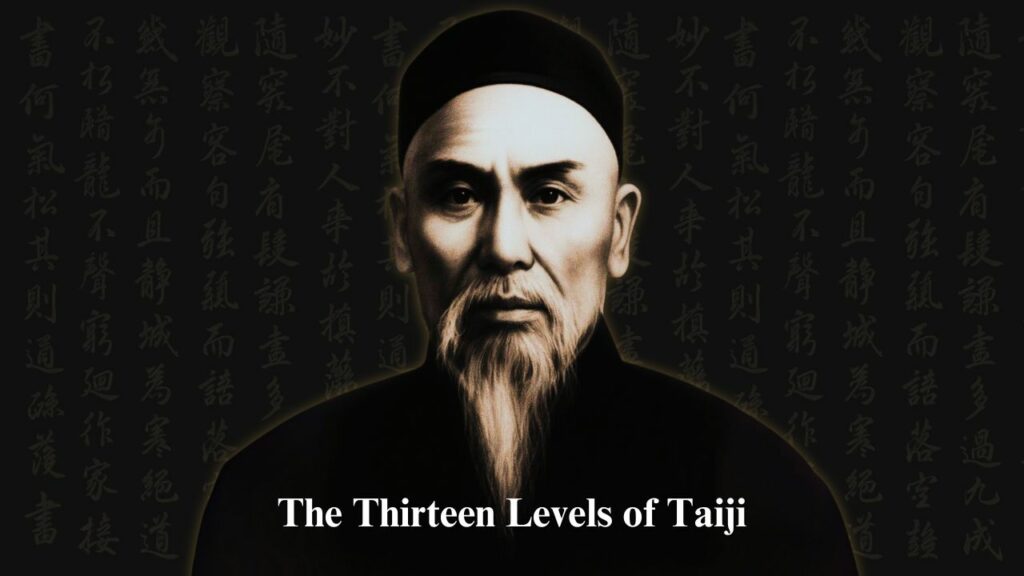
Introduction
Among the many stories preserved within Taijiquan (太极拳, Tai Chi) lineages, one in particular has captured the imagination of practitioners: the tale of a hidden diagram discovered in the private quarters of Yang Jianhou, the second son of Yang Luchan.
According to accounts passed down through disciples such as Wang Yongquan and later recorded by Wei Shuren, Wang once entered Yang Jianhou’s bedroom and saw a diagram depicting thirteen progressive levels of Taiji Gongfu (功夫). This illustration showed the stages of mastery within the Yang family’s transmission.
The Diagram of Thirteen Levels
The illustration was said to show thirteen ascending steps, with the very top inscribed “Nan Tian Men” (南天门) — the Southern Heaven Gate, a Daoist metaphor for transcendence.
- Yang Luchan (1799–1872) — founder of Yang-style Taijiquan, remembered as “Yang the Invincible,” was placed at the eighth level.
- Yang Jianhou (1839–1917) — Luchan’s second son, respected for both his martial skill and teaching, was placed at the sixth level.
- Yang Banhou (1837–1892) — elder son of Luchan, known for his fierce temper and combative small-frame practice, was placed at the fifth level.
- Yang Shaohou (1862–1930) — eldest son of Jianhou, famous for his demanding, fast, small-frame Taiji, was placed at the fourth level.
What is striking about this record is the candor of its hierarchy: even the most celebrated members of the Yang family did not place themselves at the uppermost levels.
The Meaning of Each Level
Yang Jianhou is said to have explained the significance of the steps:
- The first level was Dong Jin (懂劲) — understanding jin (劲), the refined force or trained power in Taijiquan that differs from raw strength (li 力).
- The second level was Hui Yong Jin (会用劲) — applying jin, putting that understanding into practical use.
- The stages continued in this way, progressively refining body, mind, and intent.
- The thirteenth level was described as Chu Shen Ru Hua (出神入化) — to transcend into the divine, achieving a state of effortless perfection, beyond ordinary human capacity.
Yang Jianhou reportedly admitted that no one in the Yang family had yet reached the thirteenth level. This humility reinforces a timeless truth: in the internal arts, there is always a higher mountain to climb.
Tradition, Legend, and Meaning
It is important to recognize that this story comes from Yang family lore, passed down orally and in private writings. Whether or not the original diagram still exists, the tale reflects the way the Yang masters understood Taijiquan: as a progressive art with profound depths, far beyond mere external movement.
Rather than a rigid ranking system, the thirteen levels should be viewed as a roadmap of cultivation — guiding practitioners from entering the door of Taiji to approaching the pinnacle of transformation.
A Teaching Story
Personally, I regard stories like this less as historical records and more as teaching stories. My own teacher encouraged me not to get caught in debating whether such accounts are literally factual, but instead to ask: what lessons do these stories carry, and how can we learn from them?
From this particular story, two important lessons emerge:
- Understanding is the gateway. In Taijiquan, this begins with Dong Jin (懂劲) — understanding jin (劲). Without this, there is no true entry into the art.
- Humility is essential. Even Yang Luchan, the founder of Yang style and a figure remembered as “Yang the Invincible,” was placed only at the eighth level, with higher levels still beyond him. This reminds us that no matter how great our skill, we must never stagnate or become content. Instead, we should maintain the mindset that there are always deeper levels to reach — even if they remain beyond our present grasp.
In this way, the story reminds us that Taiji is not about claiming completion, but about continually walking the path — always refining, always aspiring, always climbing higher.

Just curious, could you please tell me where you managed to find this memorable story about the diagram? You seem to be the only source on the internet. Maybe in the recordings of Wei Shuren, which for me are also impossible to find? Even AI couldn’t find any direct source, but did manage to trace Shuren’s book 杨式太极拳术述真 (Yang shi taijiquan shu when) 1999, People’s Sports Publishing House (Beijing), in which, according to ChatGPT, he might have included this story. Would be nice to know more.
Hi Betty, this story comes through Wang Yongquan, and later recorded by Wei Shuren, in the text 《杨氏太极拳秘辑传承源流简解》 (Yang Shi Taijiquan Miji Chuan Cheng Yuan Liu Jian Jie). That’s where the story of the 13 levels and the diagram in Yang Jianhou’s bedroom is recorded.
Thanks a lot for this great article. Do you know all the other levels from 3 to 12?
Glad you enjoyed it. As far as I know, the original story only gives detail on the 1st, 2nd and the 13th levels. The middle levels (3–12) aren’t clearly explained in the sources we have and there’s no authoritative list I’m aware of that survives today.
Allright,thank you for your kind reply !
This article is a great reminder that the ultimate goal of practicing Taijiquan is to cultivate the Shen to transform it to Vacuity and thus unite with the Dao 🙏